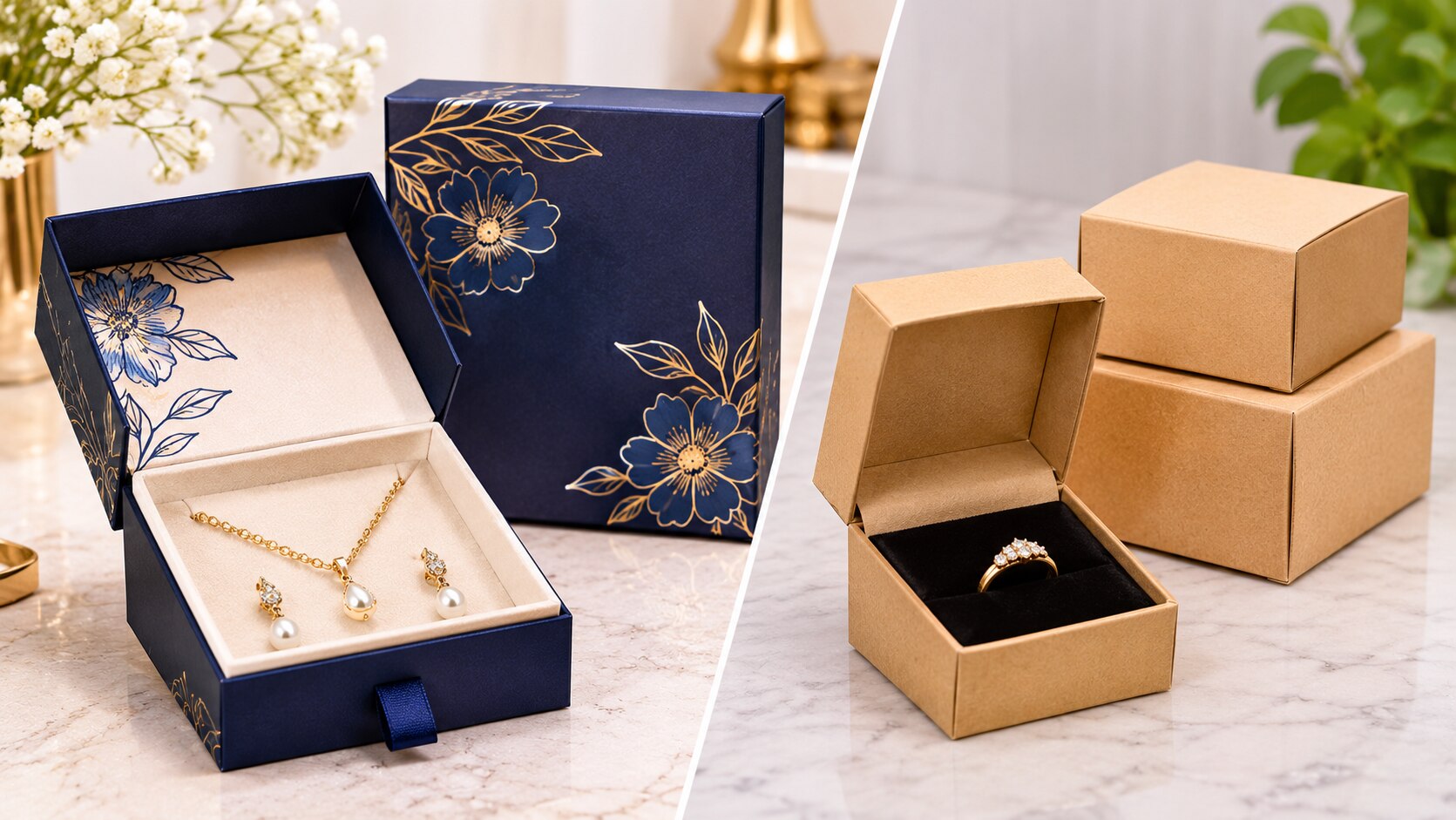
The right jewellery box depends on more than appearance: order quantity, delivery date, product fit, branding method, storage capacity, and repeat demand all change the economics. By comparing these factors, you can choose a stock box, a branded stock structure, or a fully custom package without paying for features your jewellery range does not need.
Key takeaways
- Choose stock boxes for uncertain demand and small, immediate orders.
- Use custom boxes for repeat products, exact fit and consistent brand presentation.
- Compare landed cost, minimum quantity, lead time and storage before ordering.
- Specify box dimensions, closure, material, insert and print requirements in writing.
Stock and Custom Jewellery Boxes Are Different Specifications
A stock jewellery box is an existing box specification; a custom jewellery box is made to your required dimensions, closure, material, and internal fit. The distinction behind “jewellery box manufacturer in Jaipur custom printed versus stock boxes” is that custom printed and custom made do not mean the same thing.
| Option | Structure | Branding and insert |
|---|---|---|
| Stock box | Ready-made size, board, colour, closure, and available insert | Add a sleeve, sticker, belly band, or printed insert; select from existing inserts |
| Custom box | Develop dimensions, compartments, closure, board, and material | Print artwork on the box and specify a made-to-fit insert |
| Custom structure with later branding | Build a new box without printed board | Apply a label, sleeve, or sticker after conversion |
That is why custom jewellery boxes versus stock boxes must be quoted in separate lines. A stock rigid box can carry your logo through a sleeve, while a structurally custom box can remain unprinted. Combining both choices into one “custom box” price hides the actual trade-off.
Ask for separate prices and specifications for:
- Structure: dimensions, board thickness, closure, material, and construction method.
- Branding: CMYK, spot colour, or digitally simulated spot colour; foil, embossing, debossing, soft-touch film, or lamination; include a physical proof because coated paper, kraft stock, fabric wrap, and dark board change colour appearance.
- Insert: jewellery dimensions and weight, material such as foam, flocked board, paperboard, moulded pulp, or fabric, retention method, colour, compression recovery, and whether it is replaceable.
A “custom insert” line alone is not precise enough to compare quotations.
Compare Landed Cost, Quantity, Lead Time, and Storage
The real comparison is landed cost per saleable box, not the quoted unit price. Include freight, taxes, packing, wastage, rejects, setup, and the cost of holding unused stock.
| Cost factor | Stock boxes | Custom jewellery boxes |
|---|---|---|
| Unit price | Often lower at small quantities; branding adds sleeve, sticker, or insert cost | Higher until volume spreads tooling, printing, and finishing costs |
| Minimum order quantity | Usually low, supporting short runs and testing | Usually higher because production is made to order |
| Setup charges | Little or none for standard decoration | Add dies, sampling, printing setup, plates, finishes, and custom inserts |
| Production time | Ready stock gives the shortest replenishment route | Artwork approval, sampling, production, inspection, and freight extend lead time |
| Storage space | Standard sizes simplify stacking and reordering | Larger commitments tie up space in specific colours, structures, and sizes |
| Repeat orders | Easy to replace a small quantity, but branding may remain limited | Economical when the same design, insert, and dimensions repeat regularly |
Foil stamping, embossing, debossing, soft-touch film, and lamination add process steps and reject risk. Request a physical finish sample and confirm whether it is applied before or after box conversion.
A stock rigid box with a printed sleeve may cost less than a fully printed rigid box at low or medium volume. For custom jewellery boxes versus stock boxes, compare the inventory carrying cost of slow-moving designs against the higher unit price of flexible replenishment.
A custom insert also needs a priced specification: material, colour, jewellery dimensions, retention method, weight, and replaceability.
Choose Stock for Uncertain Demand and Custom for Repeat Presentation
If demand is uncertain, choose a stock box. It lets you replenish quickly without committing cash to one design, size, or campaign. That makes it safer for short runs, urgent events, product testing, and collections that may change before the next order.
| Option | Main advantage | When it applies |
|---|---|---|
| Stock box | Ready-made structure, colour, closure, and insert with no structural development | Immediate requirements, changing ranges, small runs, or untested demand |
| Stock box with sleeve or insert | Adds flexible branding while preserving the standard box | Corporate jewellery gift packaging, seasonal campaigns, or several recipients |
| Custom printed box | Controls dimensions, artwork, finish, closure, and insert as one presentation | Repeat orders, stable jewellery ranges, and brand-led unboxing |
Custom printed boxes justify their preparation and minimum commitment when the same jewellery range will sell repeatedly and presentation affects conversion, gifting, or brand recognition. Confirm the full landed cost, including tooling, sampling, setup, freight, taxes, wastage, and stored inventory—not only the quoted unit price.
Do not print each recipient’s name or event directly on a permanent box. That creates obsolete stock when a campaign changes. Use a stable brand-printed outer box with a variable sleeve, label, card, or insert; one base design can then support multiple corporate customers and annual campaigns.
Match the Box Construction and Insert to Each Jewellery Type
A loose insert can ruin a well-printed box: the jewellery shifts, scratches against itself, and arrives looking crushed. Match the cavity to the item, not merely the outer box size.
| Jewellery type | Suitable box construction | Insert that holds it |
|---|---|---|
| Rings | Small rigid hinged or lift-off box with adequate headroom | Slotted foam, velvet, or moulded-paper ring pad; keep the stone above the slot and avoid pressure on prongs |
| Earrings | Compact rigid box with a flat, stable base | Earring card or paired pad with holes; secure posts and backs so the pieces cannot rub |
| Pendants | Shallow box with a fixed presentation panel | Necklace card with slits or a small clasp point; keep the pendant face away from the lid |
| Bracelets | Longer rigid box or removable tray with side clearance | Curved cushion or strap panel; prevent the clasp from pressing into the finish |
| Necklaces | Long box with a restrained lid and sufficient internal length | Necklace card with two securing points and a separate channel; stop the chain folding into knots |
For custom jewellery boxes versus stock boxes, the key trade-off is fit. Stock boxes suit standard ring slots or earring pads, but a poor cavity leaves space for movement; custom dimensions and removable trays can immobilise unusual pieces without squeezing stones, clasps, or delicate surfaces.
Check the packed sample before approving production:
- Shake the closed box gently; no item should slide, swing, or strike the lid.
- Open it after transport simulation; the necklace must remain untangled and the presentation face unmarked.
- Press the lid lightly; it must not touch a raised stone or bend earring posts.
Turn the Choice into a Production-Ready Packaging Brief
Do not release a purchase order until the physical box, insert, colour proof, barcode position, and responsibility for defects are approved in writing. Give the supplier a production brief rather than a product name such as “custom jewellery box.”
1. Specify the jewellery, internal dimensions, board grade, closure, insert material, compartments, finish, quantity, tolerance, packing method, and delivery date. Quote the box structure, branding method, and insert separately: a stock rigid box can take a sleeve or sticker, while a custom-made box can still use standard unprinted board.
2. State whether artwork uses CMYK, a spot colour, or a digitally simulated spot colour. Approve a calibrated proof or production sample on the actual coated, uncoated, laminated, kraft, fabric-wrapped, or dark stock; an onscreen PDF cannot predict the finished colour.
3. For corporate jewellery gift packaging, keep recipient names and event details on a variable sleeve, label, card, or insert. A stable outer box prevents obsolete stock when campaigns change.
4. Place any barcode or QR code on the physical pack and scan it at the intended distance and orientation. Check quiet zones, contrast, foil, texture, folds, curvature, and embossing before approving the artwork.
5. Ask a jewellery box manufacturer in Jaipur or printed gift box manufacturer in Jaipur where printing, board conversion, rigid-box making, inserts, and finishing occur. Record subcontractors, manufacturing locations, and who pays for colour, dimensional, or finish defects; Riya Creation should be evaluated against the same written brief.
6. Review Legal Metrology declarations for the product’s sale format instead of assuming decorative packaging is exempt. Get the final dieline, sample, inspection standard, and replacement terms signed before production.
Related products
 | Box Printing We are a trusted box manufacturing company specializing in corrugated boxes, carton boxes, printed packaging boxes, export packaging, industrial... View product → |
 | Mono Carton Leading mono carton box manufacturer offering custom printed packaging, duplex carton boxes, pharmaceutical, cosmetic, food, FMCG, retail, and... View product → |
Frequently asked questions
What is the difference between custom printed and custom-made jewellery boxes?
Custom printed boxes use an existing box specification with your artwork. Custom-made boxes also change dimensions, closure, materials or internal fit.
When should you choose stock jewellery boxes instead of custom boxes?
Choose stock boxes when demand is uncertain, quantities are small, storage is limited or you need packaging quickly.
When are custom jewellery boxes the better choice?
Choose custom boxes for repeat presentation, consistent product fit, planned volumes and branding that must appear on every pack.
What should a production-ready jewellery box brief include?
Specify the jewellery type, internal dimensions, box construction, closure, material, insert, print artwork, finish, quantity, delivery date and packing requirements.
Keywords