
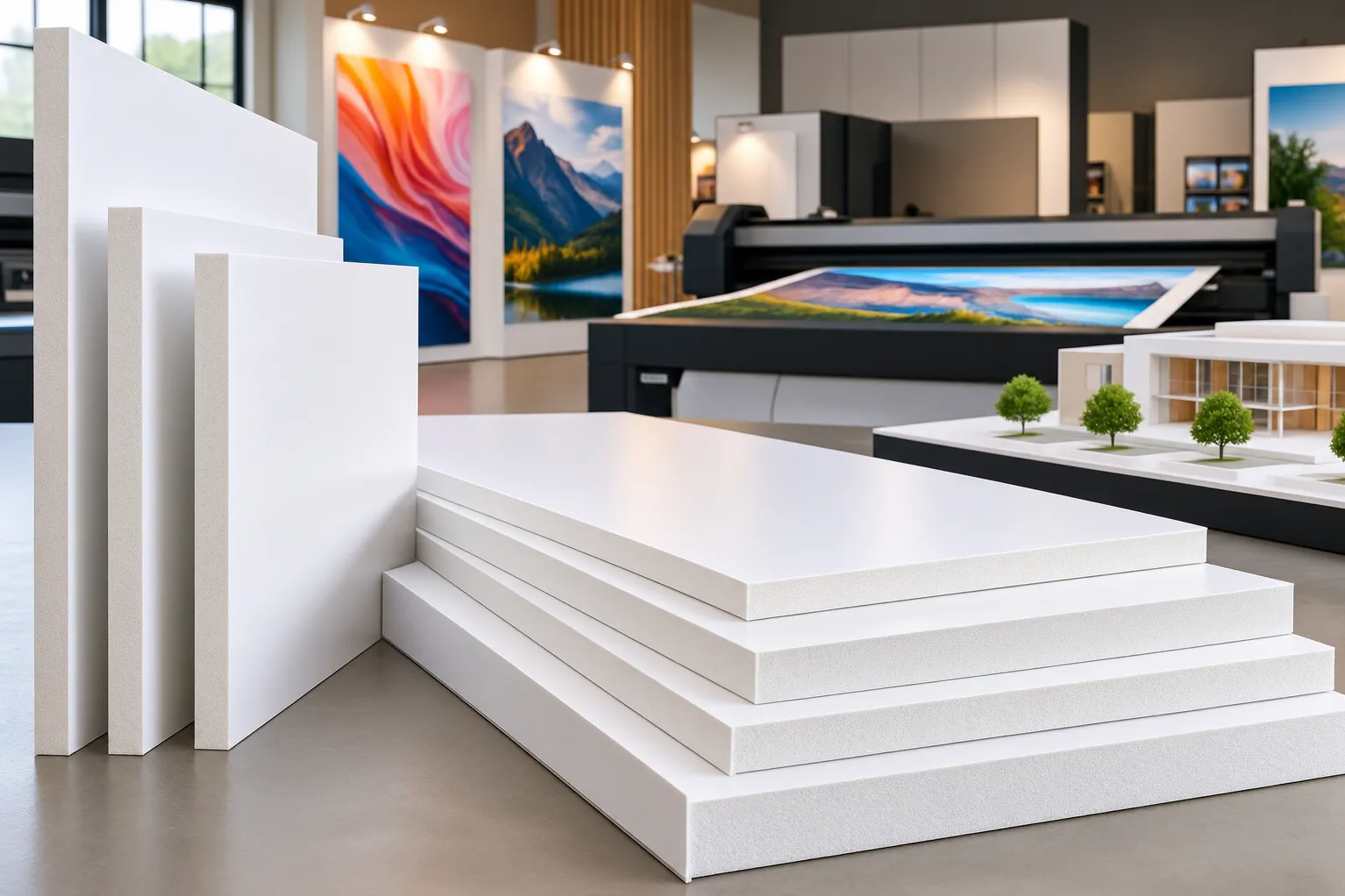
Selecting kapa paper board should involve more than choosing a thickness from a catalogue. Board properties can influence printing, mounting, cutting, display quality, handling, and the finished appearance of a project.
Businesses in Jaipur working on retail communication, presentations, displays, signage-related applications, product promotions, or specialised packaging components should evaluate the intended use before deciding on a board specification.
Define the Application First
The same board specification may not be appropriate for every project.
Start by identifying exactly what the finished board needs to do. Will it be displayed vertically? Mounted to another surface? Printed directly or used with mounted graphics? Cut into shapes? Handled frequently? Used temporarily for a campaign?
These practical questions are more useful than selecting material solely by appearance.
Thickness Affects More Than Strength
Thickness can influence stiffness, weight, edge appearance, cutting requirements, and handling.
A thicker board may provide additional rigidity for some applications, but increasing thickness without considering production and installation requirements can create unnecessary complications.
The dimensions of the finished piece also matter. A specification suitable for a small display may behave differently when used for a much larger panel.
Surface Quality Matters for Visual Work
Where graphics are an important part of the project, the board surface should be considered alongside the printing or mounting process.
Brands often focus heavily on artwork while overlooking the substrate that supports it. Yet surface uniformity and compatibility with the chosen production method can influence the final presentation.
Before committing to a large run, a representative sample can help teams assess whether the combination of material and graphics produces the intended result.
Cutting and Finishing Need Planning
Projects involving shaped components, display elements, or detailed layouts should be designed with the board's fabrication requirements in mind.
Very intricate shapes may require different considerations from simple rectangular panels. Edge visibility can also matter where the finished product will be viewed closely.
Instead of treating fabrication as a final step, designers should understand production constraints while preparing the artwork and dimensions.
Consider Handling and Transportation
A board may look perfect immediately after production but still need to travel through storage, transportation, installation, and customer handling.
Businesses should consider how finished pieces will be packed and transported, especially for large-format applications.
For companies in Jaipur supplying materials or promotional items across Rajasthan, transportation conditions can influence how completed boards need to be packed to reduce avoidable damage.
Request Samples When Specifications Are Uncertain
A sample can answer practical questions that specifications alone may not resolve.
It can help a buyer examine surface appearance, thickness, stiffness, edge quality, print presentation, and general suitability. For projects with custom cutting or printing, a prototype can also reveal design issues before quantity production begins.
Riya Creation serves commercial packaging and printing requirements in Jaipur and can discuss project specifications when businesses are considering paper-board-based solutions.
The most useful purchasing brief includes the application, dimensions, quantity, artwork requirements, printing or mounting method, finishing expectations, and intended handling conditions.
Choosing kapa paper board is ultimately an application-driven decision. When businesses evaluate the board as part of the complete production process rather than as an isolated material, they can make more informed choices about thickness, printing, fabrication, presentation, and handling.
Keywords